Custom POS displays for every sector
We design and manufacture displays and brand spaces for the sectors where the point of sale decides everything.
See all solutions →


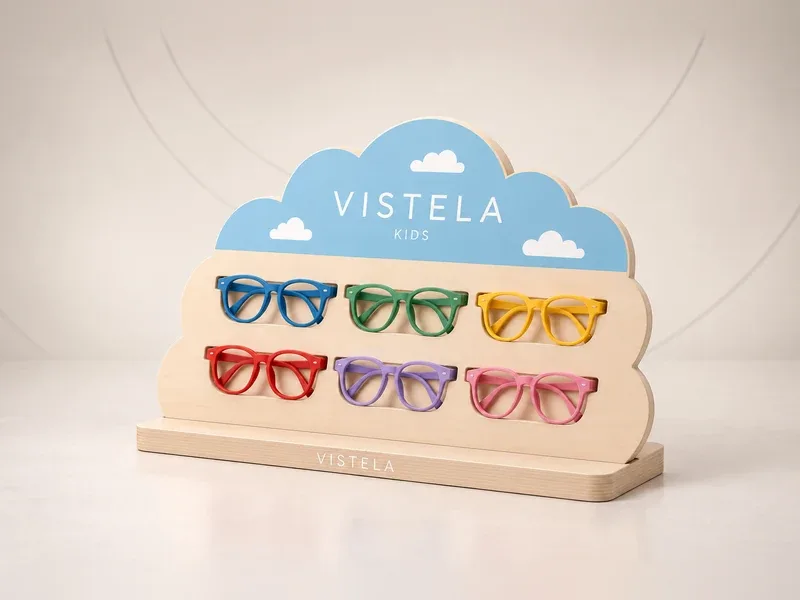
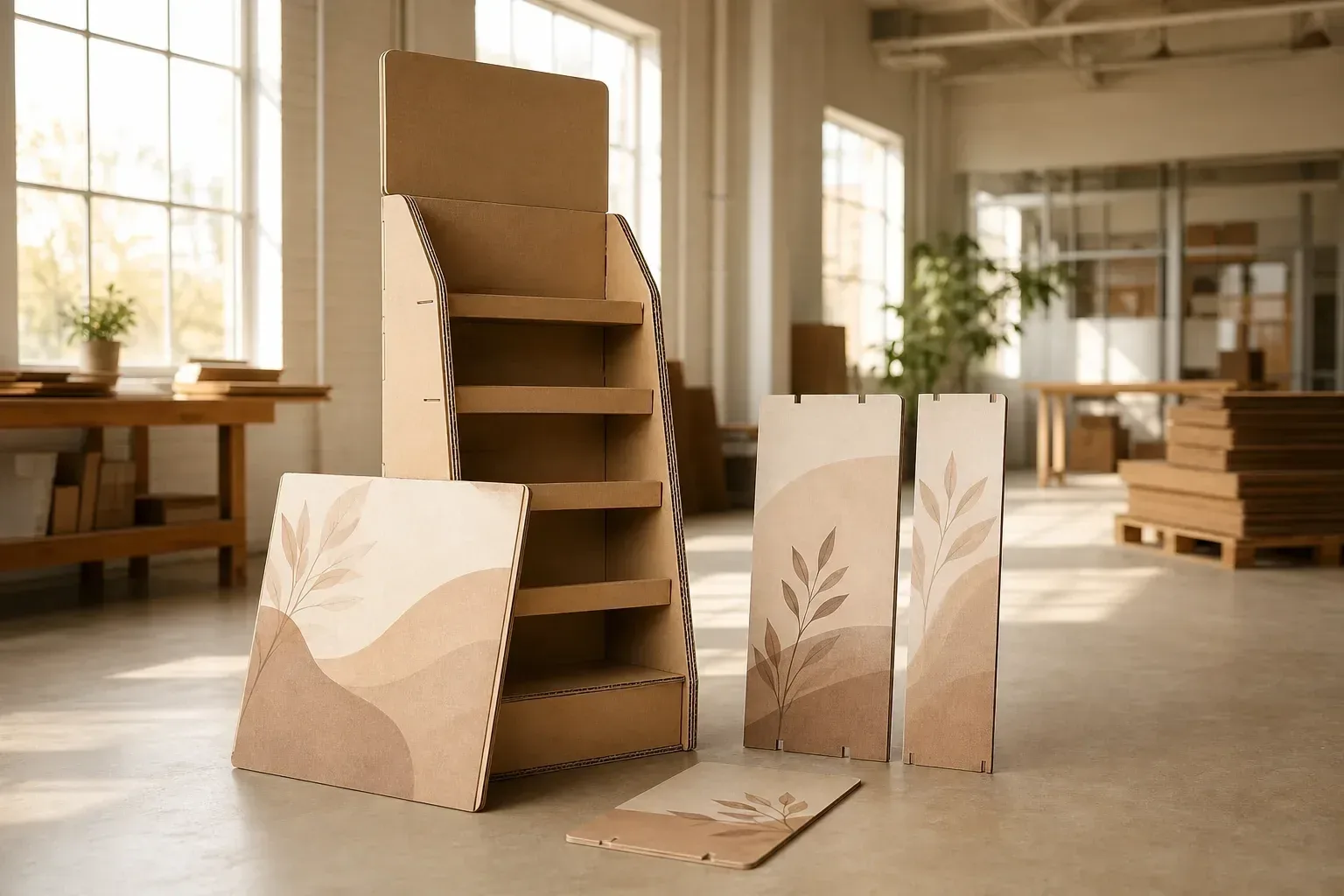
Every year, thousands of displays end up in the bin six weeks after they were made. They are designed for a single campaign, do their job on the shelf, and get thrown away. It is the dominant model in POS displays — and it is, at the same time, the most expensive and the least sustainable of all.
The alternative is not new, but it remains underused: the reusable, modular POS display. A structure that lasts for years and a set of customisable pieces that change from one campaign to the next. It is the only lever that cuts waste and cost at the same time. At Atamark we have been manufacturing POS displays for more than a decade and we have seen the difference on the balance sheet of brands that made the switch. Here is how it works and when it pays off.
1. What «modular» actually means in POS displays
A modular display separates two things that traditional POS manufacturing builds as a single piece:
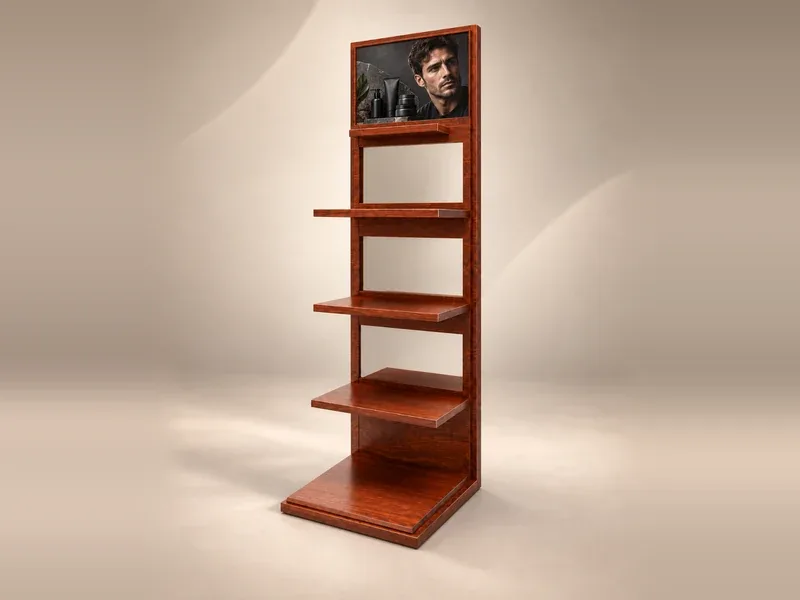
- The permanent structure: the body of the display — base, frame, shelves, column. It is built once with durable materials (metal, FSC wood, acrylic) and stays in store for 3 to 7 years.
- The customisable elements: the printed vinyl, the header, the front panel, the toppers. Lightweight, inexpensive pieces that are refreshed every 4–12 weeks for each new campaign.
The idea is simple: what communicates changes fast, but what holds it up does not have to. Instead of throwing away the whole display when a promotion ends, you only replace the graphic layer.
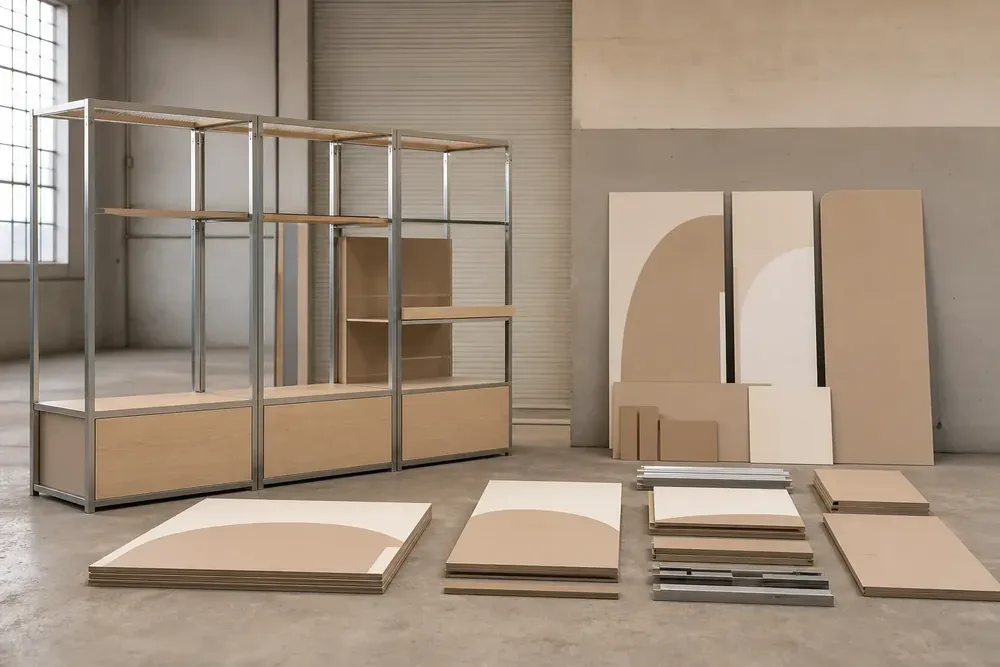
Permanent structure + interchangeable customisable panels: the principle of the modular POS display.
📖 If the big picture is not clear yet, start with the pillar guide: Sustainability in POS displays: FSC, PEFC, EUDR and carbon footprint →
2. The calculation that changes how you decide
Modularity is easier to grasp with numbers. Imagine a brand running 4 campaigns a year across 200 stores:
| Model | Manufactured per year | Waste generated |
|---|---|---|
| Non-modular | 4 × 200 = 800 brand-new complete displays | 800 structures to landfill/recycling |
| Modular | 200 structures (once) + 800 lightweight graphic pieces | Only 800 small pieces |
Over five years, the carbon-footprint (CO₂e) saving of the modular option typically sits between 60% and 75%. And the financial saving, once the higher upfront investment is accounted for, usually pays back from the second or third campaign onwards. From there, every campaign is substantially cheaper.
📖 To understand how that saving is measured, read Carbon footprint of a POS display: how to measure it →
3. How to cut waste in every campaign: five design decisions
Reuse is not improvised at the end: it is designed from the very first sketch. These are the five decisions that avoid the most waste:
- Design the structure for several campaigns, not one. Durable materials, reversible joints (screw or slot, not permanent gluing) and a neutral format that accepts very different graphics.
- Isolate the graphic layer. The vinyl, header and front panel should change without tools and without damaging the structure. The faster the in-store swap, the lower the logistics cost.
- Standardise dimensions. A family of pieces with common formats lets you reuse graphics across points of sale and reduce printing waste.
- Choose single-material parts where you can. A panel mixing laminated cardboard with plastic is hard to recycle; one of cardboard with water-based ink goes cleanly into the paper stream.
- Plan end-of-life from the start. Define now who collects, repairs and recycles the structure when its cycle is over. At Atamark we run reverse logistics with clients who have it set up with their stores.
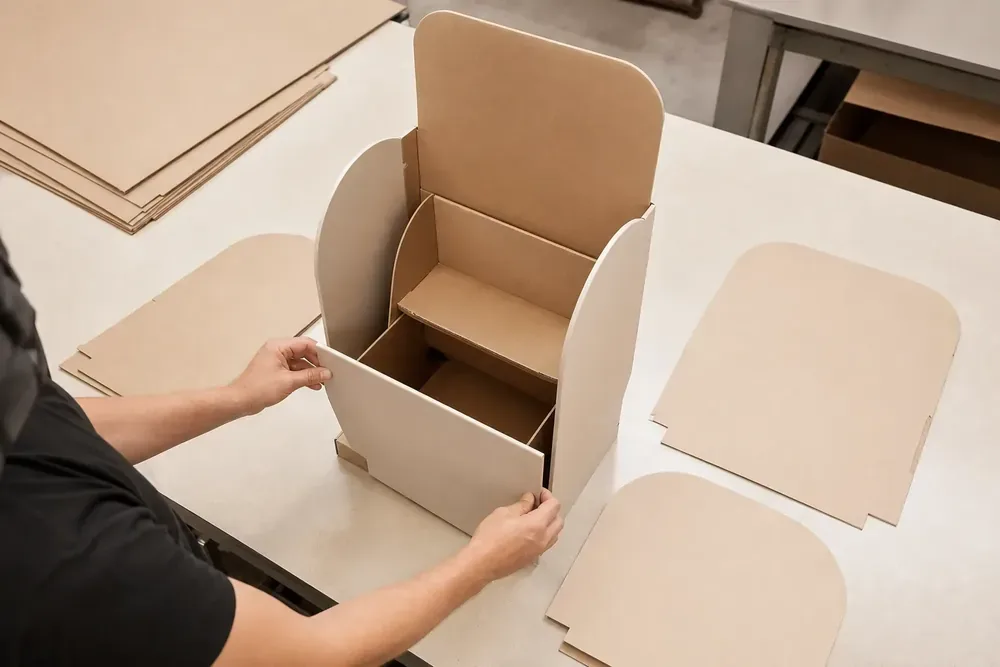
Tool-free assembly and disassembly is what allows the structure to be reused campaign after campaign.
⚠️ Key question for your manufacturer: «How many graphic swaps does this structure withstand without deteriorating? And how does it come apart for recycling at the end?» If they can’t answer with specifics, they’re not designing for reuse.
4. When modular does NOT make sense
Modularity is not a religion. For genuinely one-off campaigns — a single launch, a non-repeating seasonal activation, a pilot in a handful of stores — a permanent structure sits underused and ends up more expensive and more polluting than a good recyclable FSC cardboard display, designed to be dropped cleanly into the paper stream.
The rule of thumb:
- Short, one-off campaign (≤8 weeks, no repeat): recycled, recyclable FSC cardboard.
- Campaign-after-campaign rotation in the same store network: modular wins, almost always.
- Permanent presence (>1 year): durable structure with interchangeable graphics, no debate.
📖 Cardboard, acrylic, metal? The choice of material also weighs on the decision: FSC vs PEFC for POS displays: what to demand from your supplier →
5. The argument your internal client understands: cost and ESG at once
The modular POS display is one of the few trade-marketing decisions that improves two opposing KPIs at the same time:
- It cuts cost per campaign from the third one onwards — which procurement and finance like.
- It cuts waste and carbon footprint — which feeds the ESG report and the brand’s Scope 3 reduction commitment.
It is therefore one of the few investments you can defend to both the procurement department and the sustainability department with the same argument. The upfront investment is higher; so are the returns and the consistency.
Frequently asked questions
How many campaigns does a modular structure last?
It depends on the material: 3 to 7 years of real use, which usually equates to 12–28 campaigns if you rotate every quarter. Quality metal and acrylic sit at the top of the range; FSC wood, in the middle.
Is a modular POS display more expensive?
The upfront investment is higher because the structure is made from durable materials. But the cost per campaign drops from the second or third, since you only refresh the graphics. In the medium term it is cheaper than building new displays every time.
How much waste does a modular POS display save?
Compared with building a complete display per campaign, modular avoids reproducing the structure each time. In a 4-campaign-a-year scenario, the carbon-footprint saving usually exceeds 60% over five years, and physical waste is limited to the lightweight graphic pieces.
Can the structure be recycled at the end of its life?
Yes, if it has been designed for it: reversible joints, separable materials and minimal mixed components. That’s why it’s key to agree the end-of-life (collection, repair, recycling) before manufacturing, not after.
Let’s talk about your next modular POS display
At Atamark we have been manufacturing POS displays for more than a decade with FSC and PEFC chain of custody, and we design modular whenever the client has a campaign rotation that justifies it. If your brand repeats its presence in the same stores, it is almost certainly worth it for you.
Tell us how many campaigns and how many points of sale you handle per year and we’ll tell you, with numbers, whether modular saves you money and waste — and how much.
→ Request a quote · See our certifications · Solutions for cosmetics · Solutions for pharmacy