Custom POS displays for every sector
We design and manufacture displays and brand spaces for the sectors where the point of sale decides everything.
See all solutions →



Sustainability is no longer a marketing argument. It is a legal requirement, an expectation from your end customers and, increasingly, a decision taken inside the procurement department. If you produce brand displays for physical retail, knowing the FSC and PEFC certifications, understanding what changes with the EUDR regulation in 2026 and being able to measure the carbon footprint of a display unit is no longer optional: it is what will set your POS displays apart on the shelf and in the ESG report.
In this guide we walk you, step by step and without unnecessary jargon, through everything you need to know to make every display you place in store a defensible sustainable decision. At Atamark we have spent more than a decade manufacturing POS displays, and we know a responsible display starts long before the shelf: it starts with how the paper, the ink and the supplier are chosen.
1. Why sustainability is no longer optional in POS displays
Five years ago, “sustainable POS” was an adjective that appeared in sales brochures and brand meetings. Today it is a column in the dashboard of any serious Trade Marketing lead.
Three forces have pushed it to the centre of the conversation:
1. European regulation. The EUDR (Regulation 2023/1115 on deforestation-related products) comes into force in December 2025 for large companies and in June 2026 for SMEs. It covers wood, paper, cardboard and all derivatives. If your display contains cardboard, that cardboard will have to prove it does not originate from areas deforested after 2020. Without that documentation, your European importer cannot place it on the market.
2. Your customers’ ESG commitments. Large brands have public emissions reduction targets (Scope 3 included). Every material that reaches their stores counts towards their balance sheet. If your POS displays do not provide verifiable footprint data, they will ask you to — or switch supplier.
3. The end consumer. According to the 2024 Eurobarometer, 78% of European consumers say they take sustainability into account when buying. In cosmetics and pharmacy, the figures exceed 85%. A display that communicates real sustainability (not greenwashing) influences purchase decisions.
The conclusion is direct: if your POS displays do not document their sustainability, you are already losing ground on three fronts. The good news is documenting them is not complicated if you work with a manufacturer who has solved this years ago.
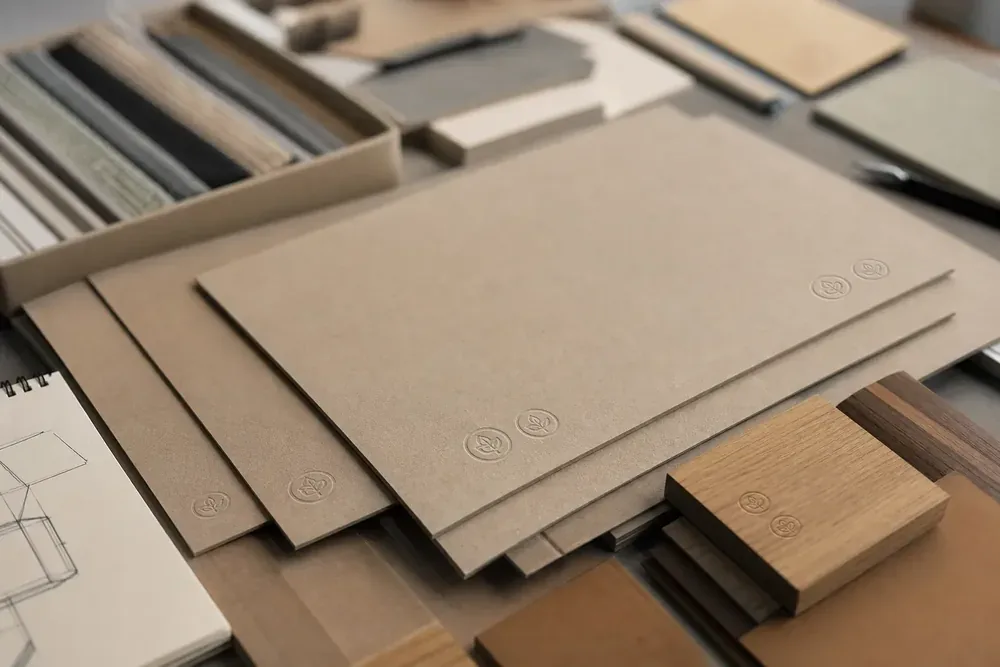
The two most recognised certifications: FSC and PEFC guarantee material comes from responsibly managed forests.
2. FSC vs PEFC: what they are, how they differ and which one your brand should demand
The two acronyms you will hear most often when requesting a quote from a POS display manufacturer are FSC and PEFC. Both certify that the wood or paper used in the display comes from responsibly managed forests. They are not the same, and choosing badly can cost you a contract.
What is FSC
FSC (Forest Stewardship Council) is an international organisation founded in 1993, headquartered in Bonn, which certifies that wood and paper come from forests managed under ten strict principles: respect for legality, workers’ rights, indigenous peoples’ rights, biodiversity conservation, protection of High Conservation Value forests, and so on.
The most demanding brands in premium cosmetics, luxury fragrance and pharmaceuticals tend to require FSC explicitly. It is the most globally recognised certification and the only one endorsed by the major environmental NGOs (WWF, Greenpeace).
There are three FSC label types:
- FSC 100%: all material comes from FSC-certified forests
- FSC Mix: combines certified, recycled and controlled-source material
- FSC Recycled: 100% post-consumer recycled material
What is PEFC
PEFC (Programme for the Endorsement of Forest Certification) is a system founded in 1999 that brings national certifications together (in Spain, PEFC España is managed by the Spanish Association for Forest Sustainability). It is the certification with the most certified area in the world, especially in Europe, where family-run and small-scale forestry finds it easier to meet its requirements.
It is the majority option among Spanish and French suppliers. Brands with a strong Western European sourcing base tend to accept PEFC without distinction.
The table you actually need
| Factor | FSC | PEFC |
|---|---|---|
| Global recognition | High, especially in international premium cosmetics | High in Europe, lower in North America/Asia |
| Global certified area | ~230 million ha | ~330 million ha |
| Environmental NGO endorsement | Yes (WWF, Greenpeace) | Partial |
| Relative cost to manufacturer | Slightly higher | Slightly lower |
| Possible labels | 100%, Mix, Recycled | PEFC Certified |
| When to demand it | Global premium cosmetics/pharma, brands with US presence | European market, food, SMEs with local sourcing |
So which one should you demand? The serious answer: both, if your manufacturer can offer them. At Atamark we operate with FSC and PEFC chains of custody simultaneously, which allows us to adapt certification to the client and the destination market without switching supplier.
📖 Read the full guide: FSC vs PEFC for POS displays: what to demand from your supplier →
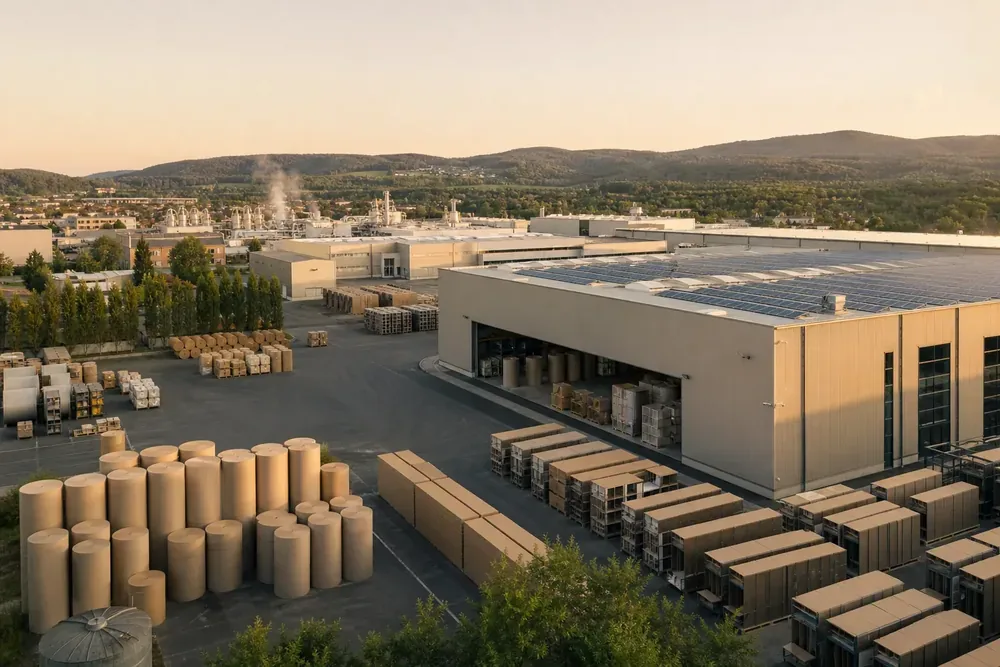
Geographic traceability of forest origin is at the heart of the EUDR Regulation. Without it, you cannot place products on the EU market from 2026.
3. EUDR Regulation 2026: the European framework that changes the game
Regulation (EU) 2023/1115 on deforestation-free products, known as the EUDR, is probably the most important European regulation of the last decade for POS display manufacturers and buyers. And many people in the sector still haven’t realised.
What the EUDR requires
Any product entering or being marketed in the European market that contains wood, paper, cardboard, rubber, cocoa, coffee, soy, palm oil or cattle, or derivatives of these materials, must prove that:
- It does not come from areas deforested after 31 December 2020.
- It complies with the legislation of the country of origin (whether Brazil, Indonesia, Sweden or Spain).
- It is accompanied by a Due Diligence Statement (DDS) with exact geographic coordinates of the source plot.
For a cardboard POS display, this means the manufacturer (or the marketer, depending on who places it on the market) must be able to trace the chain of custody back to the specific forest plot from which the wood used to make the paper pulp originated.
Key deadlines to note
- 30 December 2025: mandatory application for large companies and non-SME operators.
- 30 June 2026: mandatory application for SMEs.
If your brand buys POS displays from a European manufacturer who has not solved EUDR, in 2026 you will have an operational problem. If you buy from an Asian or Latin American manufacturer without documented traceability, placing the product on the European shelf will simply be illegal.
How compliance works in practice
There are three levels of response across the sector:
- The manufacturer with consolidated FSC and PEFC already has 80% of the requirements covered. The chain-of-custody systems of both certifications automatically generate the geographic traceability that complies with the EUDR.
- The manufacturer who only works with an “eco” paper supplier without formal certification will have to document everything manually — a significant effort for every order.
- The manufacturer who has not prepared simply will not be able to produce for the European market from June 2026.
⚠️ Key question for your current manufacturer: “Do you already have EUDR due diligence in place? Can you send me an example of a recent DDS?” If the answer is vague, find an alternative before it is too late.
4. Carbon footprint of a display: how it is measured and how it is reduced
The carbon footprint of a POS display is measured in kilograms of CO₂ equivalent (kg CO₂e) and is calculated by adding the emissions of four phases: raw materials, manufacturing, transport and end-of-life (recycling, landfill, incineration).
There is no single “correct” figure — it depends on the size of the display, the materials and the kilometres of transport. But there are orders of magnitude that help with decisions.
Indicative comparison by material
For a standard countertop display (~50 cm × 30 cm × 80 cm):
| Material | Estimated footprint (kg CO₂e) | Notes |
|---|---|---|
| FSC microflute cardboard | 2-4 | The lowest if the paper is recycled |
| FSC solid cardboard | 4-8 | Higher paper density |
| FSC wood (MDF/plywood) | 8-15 | Depends on glue type |
| Acrylic (PMMA) | 25-40 | Petrochemical, high initial footprint |
| Lacquered metal (steel) | 30-50 | But 5–10× longer useful life |
| Glass | 15-25 | Reusable indefinitely |
Indicative sources: Ecoinvent and Plastics Europe databases. Values are indicative for comparing materials — a formal declaration requires a product-specific LCA (Life Cycle Assessment).
The factor almost nobody measures: useful life
What really matters is the carbon footprint per use. An acrylic display that lasts 5 years in store and is used across 4 different campaigns (changing only the vinyl) has a far lower annual footprint than a cardboard display thrown out after 6 weeks.
The practical rule:
- Short campaign (≤8 weeks): recycled FSC cardboard is the lowest-footprint option.
- Mid-length campaign (3-12 months): solid FSC cardboard or modular FSC wood.
- Permanent (>1 year): metal or modular glass, where the custom vinyl is swapped each campaign.
📖 Go deeper in How to measure the carbon footprint of your display →
Five concrete levers to reduce footprint
- Demand paper with declared post-consumer recycled content (not just “recycled”, which can mean pre-consumer industrial waste).
- Insist on water-based inks instead of UV or solvent inks. The difference in VOCs (volatile organic compounds) is enormous.
- Design modular: a permanent structure with interchangeable custom pieces.
- Optimise packaging and logistics: consolidate orders, fold for transport, avoid shipping air.
- Close the loop: agree with your manufacturer on a return-and-recycle plan at the end of the campaign. At Atamark we work this way with clients who have reverse logistics with their stores.

Permanent structure plus interchangeable customised panels: the single most efficient lever to reduce footprint and cost per campaign.
5. Reusable and modular POS displays: savings you can see on the balance sheet
This is the most underused lever of real sustainability in POS displays. And the only one that reduces footprint and cost at the same time.
What “modular” means in POS displays
A modular POS display has a permanent structure (the body of the display: shelves, base, frame) and customisable elements that change campaign by campaign: the graphic vinyl, the header, the front, the toppers. The structure can last 3 to 7 years depending on material; the customisable parts are refreshed every 4-12 weeks.
The calculation that changes how you decide
Imagine you run 4 campaigns a year across 200 stores:
- Non-modular option: 4 × 200 = 800 new displays per year, each with its full manufacturing + transport + end-of-life footprint.
- Modular option: 200 permanent structures (one-off) + 4 × 200 = 800 small customisable pieces per year, each with a fraction of the footprint.
Over 5 years, CO₂e savings typically run between 60% and 75%. Financial savings, once the higher initial investment is amortised, usually break even by the second or third campaign.
When modular does NOT make sense
For genuinely one-off campaigns (a single launch, a non-repeatable seasonal activation), a recycled and recyclable FSC cardboard display is more efficient than an underused permanent structure. Modularity wins when there is campaign-to-campaign rotation.
📖 Read Reusable and modular POS displays: how to reduce waste in campaigns →

Physical verification at the plant is the only serious way to confirm that a manufacturer delivers what they promise on paper.
6. What to demand from your manufacturer: the 8-point checklist
If you are going to hire a POS display manufacturer in 2026 and sustainability weighs in your decision (it should), these are the eight points to verify before signing:
- Valid FSC and PEFC chain of custody: “we work with FSC paper” is not enough. You need to see the chain-of-custody certificate with the code.
- EUDR due diligence implemented: ask for an example of a recent DDS with geographic coordinates.
- Water-based inks and varnishes: documentation from chemical suppliers.
- VOC (Volatile Organic Compounds) control under EN 71-3 standard.
- Capacity to manufacture modular: they must know how to design permanent structures with interchangeable pieces.
- Logistics traceability: can they fold for transport? Do they optimise routes?
- End-of-campaign return-and-recycle service or, at the very least, a local partner with the client to manage it.
- Capacity to supply data for the client’s ESG report: estimated footprint, % recycled content, applicable certifications. If your manufacturer cannot supply this data, they will make your life harder.
🎁 Download our POS Display Sustainability Checklist (PDF, 18 points) for free — the extended version covering which documents to request and how to verify them. Download PDF →
7. What’s next: 2026-2028 trends in POS display sustainability
The EUDR Regulation is only the beginning. Over the next 24 months these will come into force or consolidate:
- EU Packaging and Packaging Waste Regulation (PPWR): approved in 2024, it requires that packaging (including certain product-associated POS material) meets minimum recycled and reusable content thresholds before 2030.
- Digital Product Passport (DPP): starts in 2027 with batteries and textiles, but packaging and POS displays are in the queue. Every product will need a code that allows its footprint, materials and recyclability to be traced.
- Biodegradable inks and bioplastics: industrial supply is maturing. Within 2-3 years, options that are prototypes today will be cost-competitive.
- POS displays with verified climate-neutrality certification: pioneer brands are already requiring this from their manufacturers for flagship campaigns.
Brands that prepare today will have the supply chain and documentation ready when these requirements become mandatory. Those that wait will see competitors gain shelf time and category share.
Frequently asked questions
Which is better, FSC or PEFC, for POS displays?
It depends on the market and the end client. FSC has greater international recognition and environmental NGO endorsement; PEFC has more certified area in Europe and is usually slightly cheaper. The ideal option is to work with a manufacturer certified in both — that way you can adapt certification to each client without changing supplier.
When does the EUDR regulation come into force for my company?
30 December 2025 for large companies (non-SMEs) and 30 June 2026 for SMEs. It applies to all products containing wood, paper or cardboard entering the European market, including POS displays.
What is the carbon footprint of a cardboard POS display?
For a medium-sized countertop display (50×30×80 cm) in FSC microflute cardboard, the indicative footprint is between 2 and 4 kg of CO₂e. This includes raw materials, manufacturing, standard transport and end-of-life (recycling). The exact figure requires a product-specific Life Cycle Assessment (LCA).
Which inks are most sustainable for POS displays?
Water-based inks are the most widely used option with the lowest environmental footprint. They contain fewer VOCs, less toxicity, and allow much cleaner cardboard recycling. UV and solvent inks are more resistant but less sustainable.
Is cardboard POS material really recyclable?
Yes, if it is well manufactured: cardboard without plastic lamination, inks compatible with recycling and minimal non-cellulosic elements (staples, plastics, magnets). A display designed for recycling can enter the standard paper-cardboard stream at the end of the campaign.
Is modular POS worth it if I only run 2-3 campaigns a year?
From the second or third campaign onwards, yes. The initial investment is higher, but CO₂e savings exceed 60% over 5 years and cost per campaign drops from the fourth onwards. For one-off campaigns or pilots, recyclable FSC cardboard is usually more efficient.
Let’s talk about your next sustainable POS display
At Atamark we have spent more than a decade manufacturing POS displays with FSC and PEFC chains of custody. We have prepared our supply chain for EUDR ahead of the deadline and design modular whenever the client can take advantage of it.
If your brand wants documentable sustainable POS displays — for your ESG report, to meet your client’s requirements or simply so your shelf communicates what your brand is already doing — tell us about your next project. We send you an initial concept and budget range within 24 hours, with the sustainability and footprint options already costed in.
→ Request a quote · See our certifications · Solutions for cosmetics · Solutions for pharmacy